
CASE STUDIES
DIGITAL RECONSTRUCTION of ANTIQUE JEWELRY
Through contemporary visualization, historical jewelry sketches are translated into realistic images, allowing unrealized designs to be experienced in a modern context. Positioned between archival heritage and contemporary aesthetics, the project offers museums, private collections, and cultural institutions a refined way to reveal, interpret, and preserve historical design legacies.
GOLD RING WITH RUBY
Italy, late 16th century. Digital visualization based on a Renaissance jewelry sketch
SOURCE MATERIAL
Source: archival jewelry drawing. The print of a design for a ring from Pierre Woeiriot de Bouzey's 1561 book, Livre d'Aneaux d'Orfevrerie
(according to an internet AI search engine)
Technique: ink on paper
Period: Italian Renaissance
Status: no evidence of physical execution of design
The digital reconstruction is based on the jewelry historical drawing preserved as an archival sketch. Such drawings were commonly used to record design intentions, many of which were never executed and survive only on paper.

VISUALIZATION APPROACH
The digital visualization follows the original proportions, ornamental structure, and stylistic language of the drawing. Historically appropriate materials - gold and ruby - were selected to reflect period practices, with the aim of preserving the integrity of the original design rather than reinterpreting it.
The goal is not to redesign the object, but to translate the drawing into a realistic, three-dimensional representation while preserving the integrity of the original concept.
Digital visualization technology makes it possible to display historical objects made from different materials.
So in this case, a gold ring with a ruby can be presented as a silver ring with an emerald.

Option 1: Gold ring with a ruby

Option 2: Silver ring with an emerald
The project offers institutions a refined tool for expanding access to historical designs that exist only in archival form.
Suitable for museum exhibitions, digital archives, and educational or curatorial contexts.
PENDANT WITH FOUR PEARLS, AND CIPHER OF ROMAN LETTERS
Demonstration of methodology for transforming a historical jewelry sketch into a precise, museum-grade visual reconstruction based on the drawing of
Hans Holbein the Younger
SOURCE MATERIAL
Source: archival jewelry drawing. The British Museum. Department: Prints and Drawings
Registration number: SL,5308.14
Technique:
black ink on paper
Period: 1532-1543 (circa)
Status: no evidence of physical execution of design
DESIGN ANALYSIS
Museum experts identify the drawing as a depiction of a jewelry pendant with four pearls and an unidentified central gemstone.
The original drawing showed only the front of the jewel, with no technical details of materials or construction. In addition, the sketch does not show a ring for a chain or ribbon, which is usually done for classic pendants.
Thus, as visualizers, we can assume that, despite the opinion of museum experts, this may not be so much a pendant as a brooch with a clasp on the back, located horizontally.

Moreover, the original drawing shows that the four gemstones symmetrically positioned at the corners of the jewel do not resemble round pearls, but instead display a faceted geometry. This allows us to reasonably conclude that these four elements are not pearls, as some experts have suggested, but rather cut sapphires, rubies, or other faceted gemstones.
So we created 2 versions of this piece of jewelry: one, according to museum experts, decorated with round pearls and sapphire, and the other, our version, with faceted rubies and a diamond in the center.
This demonstrates all the advantages of digital reconstruction, as we can see different versions of the original drawing.

Version of the jewel with pearls and sapphire

Version with faceted rubies and a diamond
REVERSE RECONSTRUCTION (not present in the Original sketch)
Let's continue our assumption that this isn't a pendant, but rather an overgrown decoration, quite typical of that era. Such brooches were pinned to the suit or dress of noble aristocrats.
TECHNOLOGY
The reverse side of the brooch was reconstructed using historical technological logic, not artistic imagination.
Because the original sketch did not show the back, the reconstruction relied on known fastening systems used in 16th-century European jewelry.
The fastening was designed as a simple horizontal pin mechanism, positioned across the central bar behind the diamond - technologically plausible for the time and consistent with surviving historical examples. Surface irregularities, asymmetry, and structural simplicity were preserved as part of historical authenticity.

METHODOLOGICAL PRINCIPLE
This case illustrates our core principle:
- We do not modernize historical jewelry.
- We reconstruct it as a craftsman of the period would have made it, using the logic, tools, and limitations of their time.
The final visuals were produced in a museum catalog photography style: neutral black background, controlled studio lighting, and no decorative staging - allowing the object itself to remain the sole focus.
APPLICATION
This approach is suitable for:
- Museum and archive visualizations
- Exhibition proposals
- Academic publications
- Cultural heritage presentations
- Jewelry history research and education
Each project follows the same strict methodology, ensuring consistency, credibility, and curatorial integrity.
ANCIENT ROMAN GOLD NECKLACE
Reconstruction based on an archival drawing
SOURCE MATERIAL
Source: archival jewelry drawing. Date issued: 1890
Technique: ink on paper
Period: Ancient Rome
Status: no evidence of physical execution of design
The digital reconstruction is based on the jewelry's historical drawing preserved as an archival sketch in the New York Public Library. Image ID: 831973


VISUALIZATION APPROACH
This digital reconstruction presents an ancient Roman gold necklace recreated directly from an archival graphic source. The form, proportions, ornamentation, and construction details follow the original sketch without modern reinterpretation.
The visualization emphasizes historically plausible materials, primitive fastening methods, and the functional logic of Roman jewelry craftsmanship, offering a museum-oriented interpretation of the object as it may have existed in antiquity.

Option 1: Gold necklace, "museum" reconstruction


Option 2 - Modifications: a cord is attached to the necklace. The technique and material correspond to the era of the jewelry - Ancient Rome.
EARRINGS WITH ASYMMETRICAL FLORAL AND ABSTRACT MOTIFS
This case explores the transformation of a single 18th-century jewelry drawing into a complete, historically coherent pair of earrings. The earing
designed by Giovanni Sebastiano Meyandi
SOURCE MATERIAL
Source: Historical jewelry drawing. Date issued: 1755
Technique: ink, green & brown watercolor on paper
Period:
Early 18th-century, Rococo style. Italy
Status: no evidence of physical execution of design
The digital reconstruction is based on the jewelry's historical drawing preserved in the Cooper Hewitt, Smithsonian Design Museum, USA.
The original archival sketch depicts only one earring. Based on period-specific construction logic, symmetry principles, and jewelry-making practices of the era, the missing counterpart was reconstructed without altering the original design language.


VISUALIZATION APPROACH
The project demonstrates several levels of visualization derived from the same historical source:
- Museum-grade reconstruction
A strict visual reconstruction focused on historical plausibility, material logic, and structural consistency with 18th-century jewelry techniques. This version is intended for archival presentation and curatorial context.
- Catalog visualization
A photographic-style rendering presented on a black background with a mirrored surface, allowing the object to be perceived as a complete, tangible artifact. This format is suitable for museum catalogs, publications, and digital archives.

Museum-grade reconstruction

Catalog visualization
- Pair reconstruction
Visualization of the complete set, showing both earrings together, emphasizing symmetry, scale, and ornamental rhythm - elements essential for understanding the object as a functional pair rather than an isolated fragment.
- Editorial presentation
A modern visual interpretation in which the reconstructed earring is worn by a model, demonstrating how a historical object interacts with the human form. This version is designed for editorial use, exhibitions, and cultural storytelling across print, digital platforms, and social media.

Pair reconstruction

Editorial presentation
This case illustrates how a single archival drawing can be expanded into multiple visual narratives - scholarly, documentary, and contemporary - while maintaining respect for the original historical source.
ANTIQUE BRACELET WITH AMAZONITE AND PEARLS
Reconstruction of an Early 19th-Century Bracelet from an Antique Drawing
SOURCE MATERIAL
Source: ancient jewelry drawing, Italy.
Technique: black ink, green and yellow watercolor on paper
Period: Early 19th century
Status: no evidence of physical execution of design.
The digital reconstruction is based on the historical drawing preserved in the Cooper Hewitt, Smithsonian Design Museum, USA.
This project is based on a colored antique drawing of a bracelet dating to the early 19th century. The original sketch represents the central ornamental section of the bracelet rather than a finalized object, offering both visual guidance and historical ambiguity.

VISUALIZATION APPROACH
The first reconstruction follows a strict museum approach, adhering closely to the drawing. Blue gemstones were selected according to the original coloration; in the initial version, amazonite was chosen for its historical plausibility and visual correspondence.
- Completion of the Object: Historical Clasp
The original drawing does not include a complete bracelet structure.
In a subsequent stage, the bracelet was completed with a historically appropriate clasp, designed in accordance with the stylistic and technological conventions of the period.
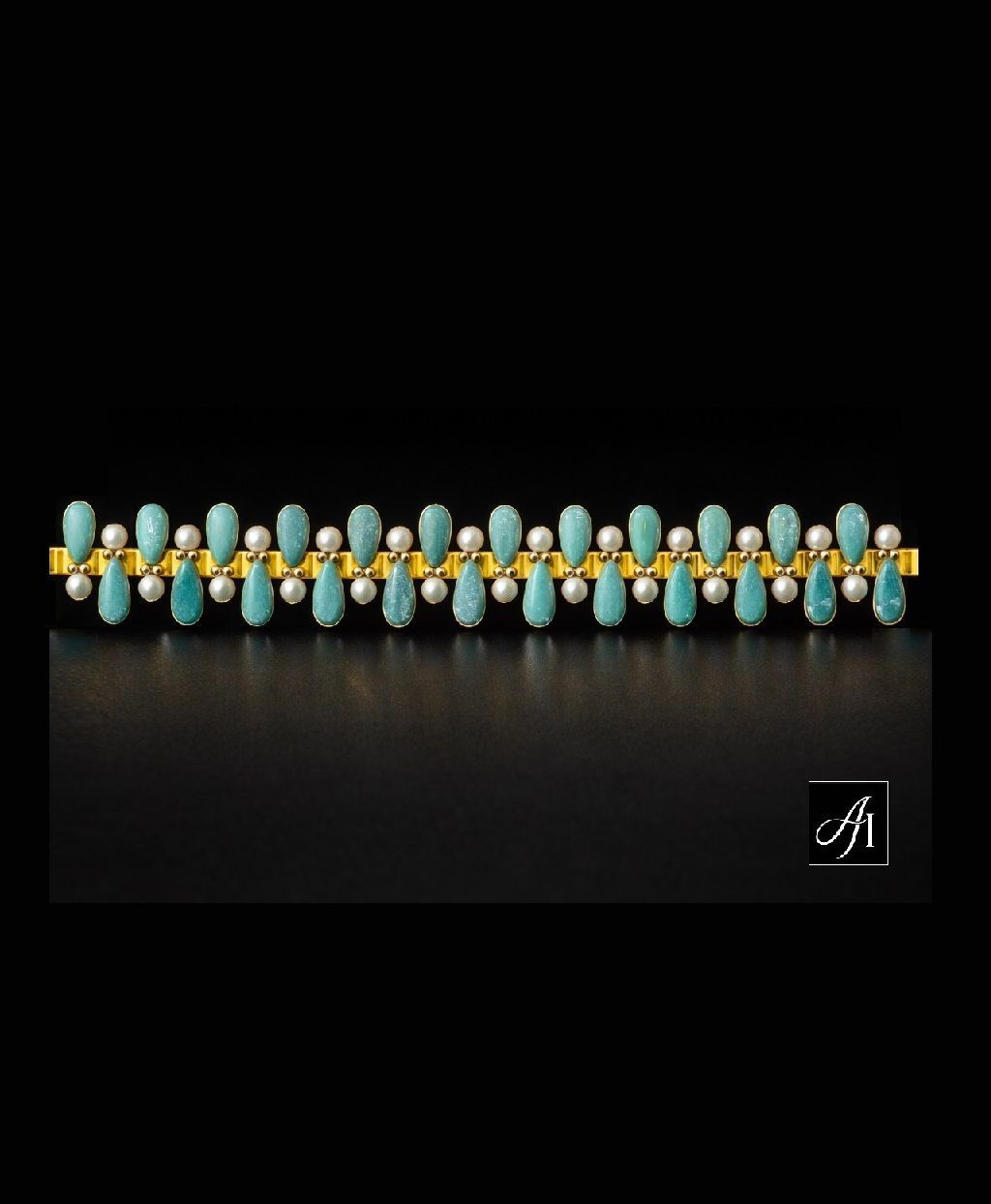
1st reconstruction: strict museum approach


2nd version: with a historically appropriate clasp
- Alternative Gemstone Interpretation
The original drawing specifies blue stones but does not indicate a particular gemstone. To explore historically plausible alternatives, a second version of the bracelet was created using turquoise, offering another interpretation consistent with the visual and material culture of the time.
- Expanded Luxurious Variation
As the drawing does not define a final configuration, an additional version was developed with an increased presence of gold elements. This variation preserving the stylistic integrity of the historical period, demonstrating how the same design could have existed in a more luxurious execution.

Alternative Gemstone Interpretation

Expanded Luxurious Variation
PROJECT OUTCOME
This case study involved in-depth analysis of the antique drawing, interpretation of its incomplete form, and the development of multiple historically grounded reconstructions. The project demonstrates how a single archival sketch can generate several credible realizations, each remaining faithful to the original visual source while exploring material, structural, and stylistic possibilities within its historical context.